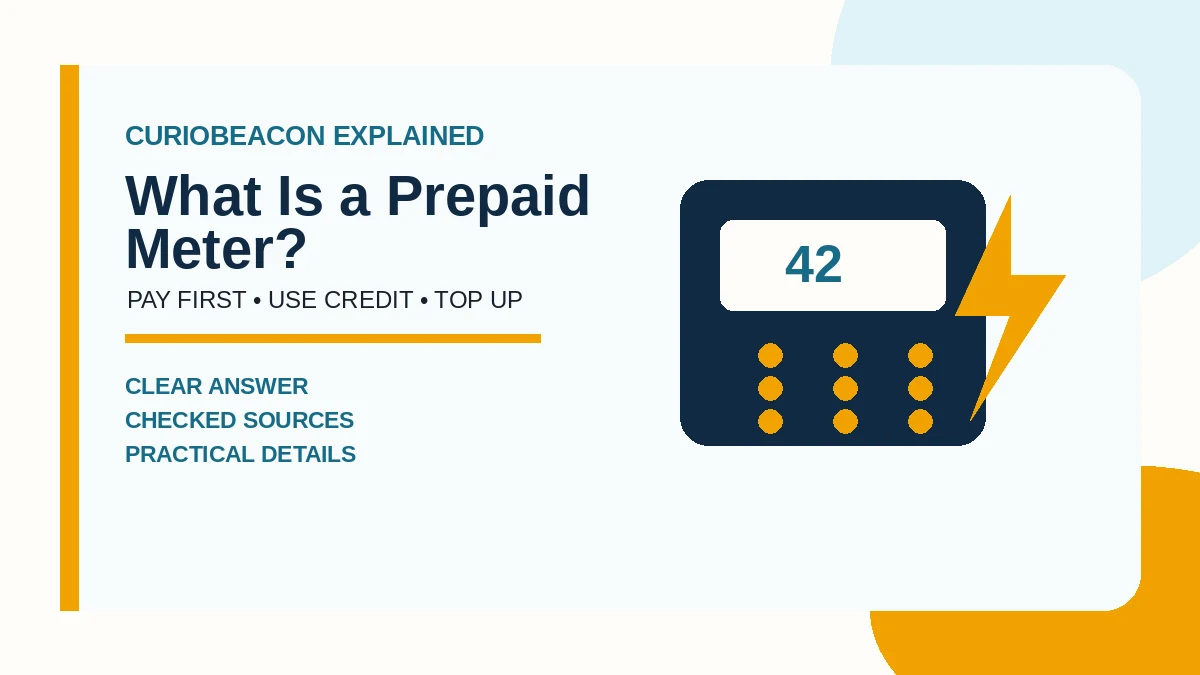
A prepaid meter is a pay-as-you-go utility meter, most often used for electricity. You add money or credit before using energy; the meter records consumption and deducts charges from that balance. When credit runs low, the system warns you, and service may stop if the balance is exhausted. Top-up methods, fees, emergency credit, and disconnection protections depend on the utility and local rules.
The term can also describe prepaid gas or water service, but most searches and consumer guidance use it to mean a prepaid electricity meter. “Prepayment meter” and “pay-as-you-go meter” usually refer to the same arrangement.
How a prepaid electricity meter works
- You fund the account first. Depending on the provider, you may pay through an app, website, phone system, retail location, card, key, or numeric token.
- The credit reaches the account or meter. A connected smart meter may update remotely. Older systems may require you to insert a key or enter a code.
- The meter measures energy use. Electricity consumption is recorded in kilowatt-hours (kWh).
- The provider applies the plan’s charges. The available money declines as energy is used and as any disclosed recurring charges or fees are assessed.
- You receive balance information. The meter, in-home display, text, email, or app may show a low-balance warning.
- You top up again. If the available balance reaches the provider’s disconnection threshold, service may stop until the account is funded, subject to applicable protections.
Prepaid vs. postpaid electricity
| Feature | Prepaid service | Postpaid service |
|---|---|---|
| When you pay | Before using the energy | After a billing period |
| Account monitoring | Balance must be watched closely | Usage and amount due appear on a bill |
| Deposit | Some plans do not require one | A provider may require one |
| If funds run out | Service may stop after required notices or thresholds | Nonpayment follows the provider’s billing and disconnection process |
| Price and fees | Depend on the prepaid tariff and provider | Depend on the selected tariff and provider |
Prepaid does not automatically mean cheaper. The Public Utility Commission of Texas advises consumers to review the plan terms closely, and its Power to Choose guidance says prepaid plans in that market can carry higher rates than non-prepaid plans. The comparison in your area may be different.
Is a prepaid meter the same as a smart meter?
No. Smart describes a meter’s ability to record and communicate usage data; prepaid describes when you pay. A smart meter can support a prepaid account or a conventional billed account. Some modern systems can switch payment modes without replacing the physical meter, while older prepaid meters may rely on a card, key, or token.
A simple balance example
Suppose an account starts with $50. During one day it incurs a hypothetical $0.50 daily charge and records 8 kWh at a hypothetical 15 cents per kWh. The usage charge would be $1.20, so the illustrated ending balance would be $48.30:
$50.00 − $0.50 − (8 kWh × $0.15/kWh) = $48.30
This is an arithmetic example, not a quoted tariff. Real plans may use delivery charges, taxes, time-of-use prices, tiers, minimum balances, debt recovery, or other terms. Use the provider’s disclosure and your actual account display for a real balance.
Advantages and limitations
Potential advantages
- Frequent balance feedback can make energy spending easier to notice.
- Some plans avoid a traditional security deposit or credit check.
- There is no surprise from accumulating an entire month of unbilled usage.
Important limitations
- You must maintain enough credit and a working way to receive alerts and top up.
- Service can be interrupted sooner than a customer expects when credit is exhausted.
- Fixed charges may continue to reduce the balance even during periods of little or no energy use.
- Rates, fees, refund rules, emergency credit, and reconnection timing are not universal.
- A household that depends on powered medical equipment should not assume a prepaid account provides uninterrupted service.
What to check before choosing prepaid service
- The full price per kWh and every recurring or top-up fee
- How and when prices can change
- The minimum balance and low-balance notification method
- Available top-up methods, hours, and processing time
- What happens overnight, on weekends, and during severe weather
- Emergency-credit and reconnection rules
- Protections for older adults, people with disabilities, and medically vulnerable residents
- How remaining credit is refunded when service ends
In the United States, utility-disconnection rules differ by state and provider. If you cannot add credit or your household has a medical or safety risk, contact the utility and the state utility regulator promptly. USAGov also points consumers to state-specific disconnection policies and the Low Income Home Energy Assistance Program (LIHEAP). Do not rely on a general article for an emergency-service decision.
Sources
- Carroll EMC Service Rules and Regulations: PrePay Service — filed with the Georgia Public Service Commission.
- Plan Options — Power to Choose, Public Utility Commission of Texas.
- Prepayment meters consumer guidance — Ofgem.
- Get a smart meter — Ofgem.
- Get help with energy bills — USAGov.