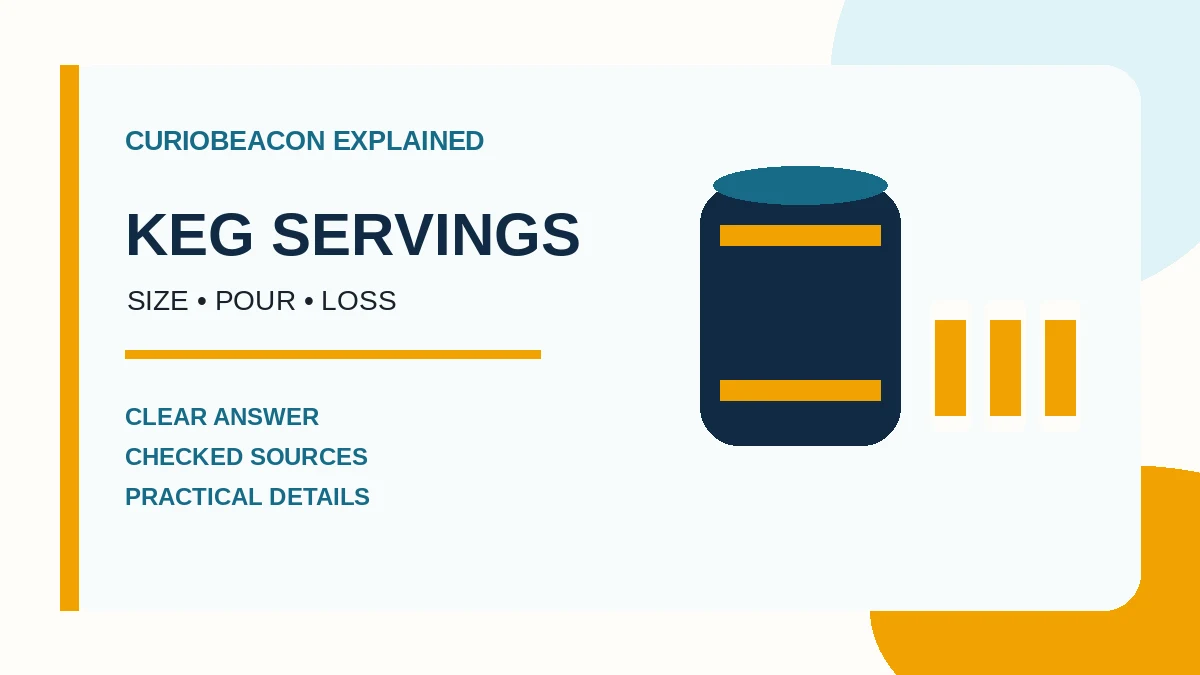
A full-size U.S. keg—also called a half-barrel—holds 15.5 gallons or 1,984 fluid ounces. That is theoretically 165 12-ounce beers or 124 16-ounce beers. A quarter-barrel holds about 82 12-ounce servings, and a sixth-barrel holds about 55. Actual yield is usually lower because foam, line loss, and incomplete pours consume some beer.
Calculate servings from a keg
Select a common keg or enter a custom capacity and serving size. The result is a volume calculation, not a promise of usable pours.
A 15.5-gallon half barrel contains 1,984 fl oz: 165 complete 12-fl-oz servings, with 4 fl oz left in the theoretical calculation.
Without JavaScript: multiply U.S. gallons by 128, then divide by the serving size in fluid ounces. Round down for complete servings.
Common U.S. keg sizes
| Keg | Capacity | 12 fl oz | 16 fl oz |
|---|---|---|---|
| Half barrel (full-size) | 15.5 gal / 1,984 fl oz | 165 complete servings | 124 servings |
| Quarter barrel | 7.75 gal / 992 fl oz | 82 complete servings | 62 servings |
| Sixth barrel | About 5.16 gal / 660 fl oz | 55 servings | 41 complete servings |
| Euro keg | About 13.2 gal / 1,690 fl oz | 140 complete servings | 105 complete servings |
The formula
theoretical servings = (keg gallons × 128) ÷ serving ounces
For a half barrel and a 12-ounce serving, 15.5 × 128 = 1,984 fluid ounces. Dividing 1,984 by 12 gives 165 complete servings with 4 fluid ounces remaining. The Brewers Association publishes the same commonly quoted 165 count.
Why you may pour fewer glasses
The table assumes every fluid ounce becomes a correctly sized serving. Real systems lose some volume to foam, beer left in the lines or keg, overfilled cups, test pours, spills, and cleaning. Temperature, pressure, line balance, glass condition, and pouring technique all affect foam. If you are planning an event, treat the calculated number as a maximum and leave a practical margin.
Make sure “a keg” means the same thing
Keg is not one universal capacity. In U.S. conversation it often means the 15.5-gallon half barrel, but sixth barrels, quarter barrels, slim quarter barrels, Cornelius kegs, and metric Euro kegs are also common. Check the capacity stamped on the keg or stated by the supplier before calculating.
The two quarter-barrel shapes—standard “pony” and slim quarter—have different proportions but the same nominal 7.75-gallon capacity. A sixth barrel is commonly listed as 5.16 gallons and 660 fluid ounces by the Brewers Association; those published figures are rounded, so avoid pretending they support more precision than shown.
Handling note
A keg is a heavy pressurized vessel. The Brewers Association warns that valves should not be removed in the field and should be serviced only by trained personnel. Use the correct coupler, keep the keg secured and cold, and follow the supplier’s instructions. This calculator is for servings, not for changing or repairing dispensing equipment.
Related CurioBeacon answers
Compare this serving calculation with A Gallon of Water Is How Many Bottles?, or learn How to Make Cold Foam?.
Sources
Checked August 22, 2026.