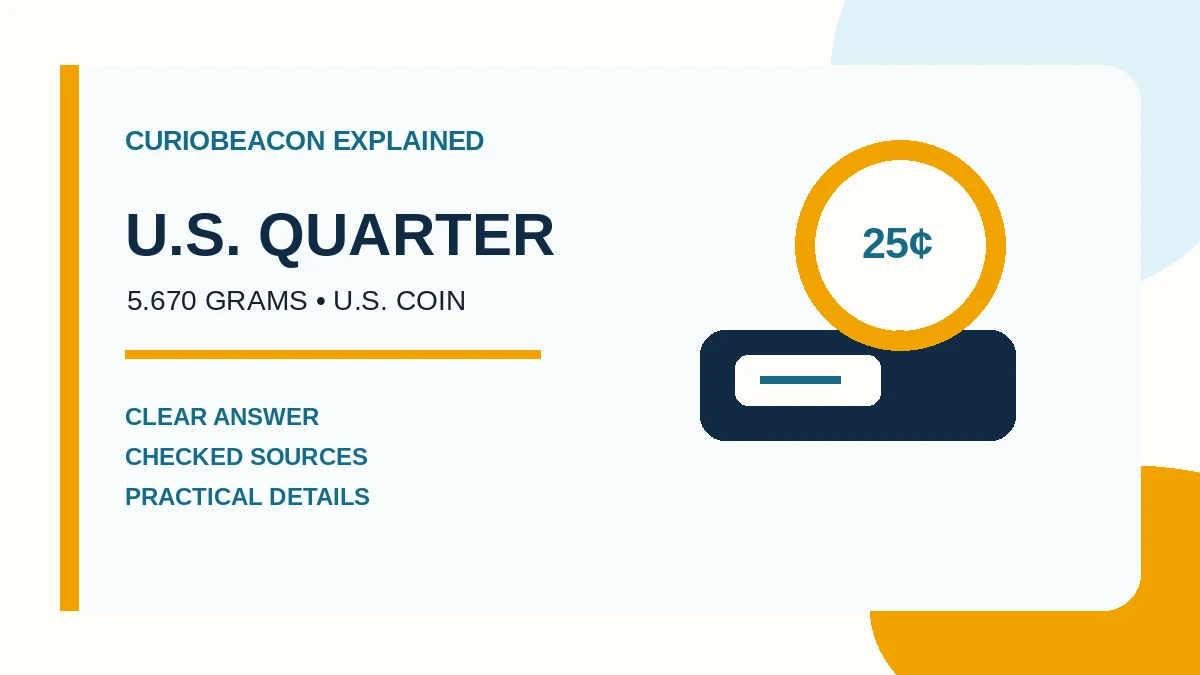
An ordinary U.S. copper-nickel clad quarter made for circulation has a specified mass of 5.670 grams. That is about 0.200 avoirdupois ounce. Forty quarters—the number representing $10—have a nominal coin mass of 226.8 grams, excluding any wrapper. Older silver quarters and modern collector issues can use different specifications, so identify the coin before comparing a scale reading.
Quarter weight in grams and ounces
The United States Mint’s quarter specification lists 5.670 grams for the circulating copper-nickel clad coin. The same page lists a diameter of 24.26 millimeters and explains that silver was removed from circulating quarters in 1965.
NIST defines one avoirdupois ounce as exactly 28.349523125 grams. Dividing 5.670 by that factor gives approximately 0.200003 ounce, normally reported as 0.200 ounce. This is an ounce of mass, not a fluid ounce. It is also not a troy ounce, the different unit commonly used for precious metals.
How much do multiple quarters weigh?
| Quarter count | Face value | Mass in grams | Mass in avoirdupois ounces |
|---|---|---|---|
| 1 | $0.25 | 5.670 g | 0.200 oz |
| 4 | $1.00 | 22.680 g | 0.800 oz |
| 10 | $2.50 | 56.700 g | 2.000 oz |
| 40 | $10.00 | 226.800 g | 8.000 oz |
| 100 | $25.00 | 567.000 g | 20.000 oz, or about 1.250 lb |
These are calculated specification values, not promises about the reading for a bag of circulated coins. Wrappers, containers, soil, wear, scale rounding, and a mixed-in foreign or collector coin can change the observed total.
Calculate a quarter total
For ordinary clad quarters, multiply the coin count by 5.670 grams:
nominal mass in grams = number of quarters × 5.670
If you know the face value in dollars and it consists only of quarters, multiply dollars by four to get the coin count. For example, $3 in quarters is 12 coins, and 12 × 5.670 = 68.04 grams. A $10 group is 40 coins, so 40 × 5.670 = 226.8 grams. Keep the final precision realistic when comparing the result with a household scale.
Why an older quarter may weigh more
| Coin type | Nominal mass | What to check |
|---|---|---|
| Ordinary circulating clad quarter, 1965 to present | 5.670 g | Date, country, denomination, and whether it is a normal circulation issue |
| U.S. silver quarter under the 1873 standard, through 1964 | 6.25 g | Date and series; circulation wear can reduce the measured mass |
| Earlier U.S. quarter | Varies by historical standard | Identify the design and year before looking up its specification |
| Modern silver, proof, or other collector issue | Product-specific | Use the Mint listing or certificate for that exact issue |
The 1873 Coinage Act set the silver half dollar at 12.5 grams and the quarter at half that mass, or 6.25 grams. The Mint notes that circulating quarters changed to copper-nickel clad in 1965. A date alone is not always enough for a modern collectible, because the Mint can sell special finishes and compositions alongside circulating coins.
How to weigh a quarter reliably
- Place the scale on a firm, level surface and let it initialize according to its manual.
- Use grams and verify that the display has enough resolution for a single coin. Tare an empty container if one is needed.
- Identify the country, denomination, date, mint mark, and apparent finish before selecting a reference specification.
- Handle a potentially collectible coin by its edge over a soft surface. The U.S. Mint cautions that cleaning or polishing can reduce a coin’s value.
- Weigh the coin more than once. If the reading moves, check the scale, surface, battery, air movement, and tare rather than averaging an unstable result.
What a scale reading cannot prove
A matching mass does not by itself authenticate a coin, establish its grade, or determine its value. A nonmatching reading does not automatically prove a counterfeit: wear, attached material, damage, the wrong coin type, and measurement error are alternative explanations. For a coin that may be rare or valuable, preserve its surface and obtain an evaluation from a reputable numismatic professional.
Related CurioBeacon answers
For another mass-and-volume distinction, read How Many Ounces Are in 750 mL?. For a reproducible count calculation, see A Gallon of Water Is How Many Bottles?.
Sources
- Quarter: Background and Specifications — United States Mint.
- NIST Special Publication 1020: Guide for Labeling Consumer Packages — National Institute of Standards and Technology.
- Coinage Act of 1873, Section 15 — U.S. Government Publishing Office.
- Caring for Your Coin Collection — United States Mint.