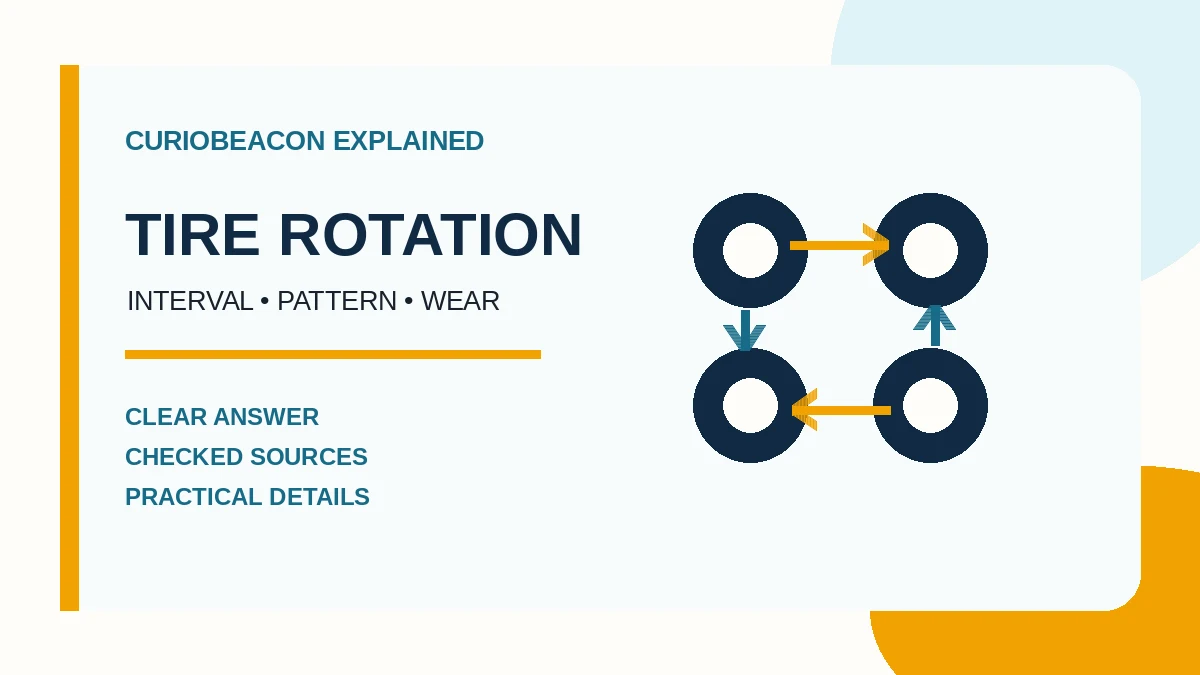
For many passenger vehicles, tire rotation is due about every 5,000 to 8,000 miles, but that range is only a general guide. Follow the interval and pattern in the vehicle owner’s manual first, then check the tire warranty. Some directional or staggered tire setups have limited rotation options or cannot use an ordinary four-tire pattern.
Use this order of priority
| Source | What to use | Why it matters |
|---|---|---|
| Vehicle owner’s manual or maintenance schedule | The stated mileage, time interval, and pattern | It accounts for the vehicle’s drivetrain, wheel sizes, and manufacturer requirements |
| Tire warranty or tiremaker instructions | Any rotation interval and recordkeeping requirement | Mileage-warranty coverage may depend on documented maintenance |
| General guidance | About 5,000–8,000 miles when the manufacturer recommends rotation | Useful only when the vehicle’s documents do not specify something different |
| Inspection findings | Earlier professional inspection for unusual wear, vibration, pulling, or damage | Rotation alone does not correct inflation, alignment, suspension, or tire defects |
NHTSA advises checking the owner’s manual for both frequency and pattern. Its general recommendation, when the vehicle manufacturer calls for rotation, is every 5,000 to 8,000 miles or sooner when uneven wear appears. AAA gives a common manufacturer range of 5,000 to 7,500 miles, while Michelin describes 6,000 to 8,000 miles as a general guideline. The overlap explains the familiar rule of thumb; none overrides the manual for a particular car.
Why tires need to change positions
Tires do not carry identical loads. Front tires handle steering and much of the braking, while driven wheels also transmit engine torque. Vehicle weight distribution, alignment, inflation, road crown, cornering, and suspension condition further affect wear. Moving compatible tires among approved positions helps distribute those differences across the set.
Rotation may extend useful tread life and keep handling more consistent, but it cannot restore worn tread or repair damage. Combine it with regular cold-pressure checks and visual inspection. For a broader maintenance schedule, see how long an oil change takes and how long a car battery lasts.
The correct pattern is not universal
- Same-size, nondirectional tires: the manual may specify a forward-cross, rearward-cross, or X pattern based on drivetrain and vehicle design.
- Directional tires: the sidewall arrow must keep pointing in the intended rolling direction. If all four are the same size, front-to-rear movement on the same side is commonly used unless the manual says otherwise.
- Staggered fitment: when front and rear tires are different sizes, they normally cannot swap axles. Side-to-side rotation may also be restricted by directional or wheel specifications.
- Full-size matching spare: it can join a five-tire pattern only when it is compatible and the vehicle or tiremaker specifies that pattern. Never insert a temporary-use spare into routine rotation.
- Dual rear wheels or specialty vehicles: follow the model-specific diagram; an ordinary passenger-car pattern does not apply.
Do not guess from drivetrain alone. Sidewall markings, different front and rear pressures, a tire-pressure monitoring system, or a nonfactory wheel setup can change the procedure. A qualified tire technician can identify the fitment before moving anything.
When to inspect before the scheduled rotation
Check the tires promptly if one shoulder wears faster, the tread is cupped or feathered, the steering wheel vibrates, the vehicle pulls, pressure repeatedly drops, or the sidewall shows a bulge, crack, cut, or exposed material. Rotation can move an abnormal wear pattern to another corner without fixing its cause. Alignment, balance, inflation, brakes, bearings, or suspension may need evaluation.
Also inspect after a hard pothole or curb impact. Do not drive on a visibly damaged tire merely to reach the normal rotation mileage. When damage or rapid air loss is present, follow the vehicle’s roadside procedure and obtain professional help.
What a complete rotation visit should include
- Confirm the manual’s interval and pattern and record the odometer reading.
- Inspect tread depth and wear across every tire, including any full-size spare that participates.
- Check for punctures, sidewall damage, aging, and wheel damage.
- Move only compatible tires according to the approved pattern.
- Set cold inflation pressure for each tire’s new axle position using the vehicle placard—not the maximum pressure molded into the tire sidewall.
- Complete any required tire-pressure-monitoring relearn and tighten wheel fasteners to the vehicle specification using the correct procedure.
- Save the dated invoice or maintenance entry for your records and tire warranty.
Should rotation happen with every oil change?
It can be a convenient reminder only when the two schedules align. Modern oil-change intervals vary widely, so “every oil change” could rotate some tires too early or too late. Compare the mileage since the last rotation with both maintenance schedules instead of assuming they are identical.
For more vehicle-care explainers, visit Cars & Transportation or read how to prevent rust on a classic car.