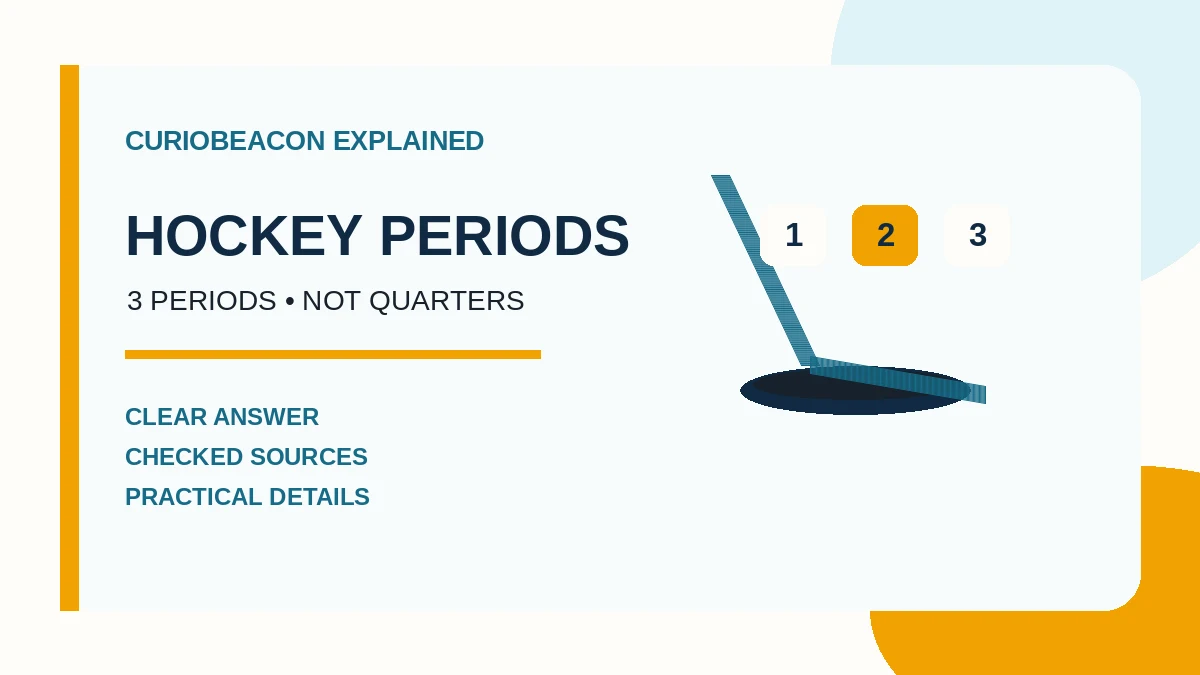
Ice hockey has zero quarters. Regulation is divided into three periods, normally 20 minutes of actual playing time apiece under NHL and IIHF rules. Intermissions separate the periods, and a tie may lead to overtime or a shootout depending on the league and competition. Field hockey is different: its standard international game uses four 15-minute quarters.
Ice hockey uses three periods
In standard ice hockey, the correct terms are first period, second period, and third period. Three 20-minute periods make 60 minutes of regulation playing time. The game takes longer than one hour in real time because the game clock stops for goals, penalties, many whistles, reviews, and other interruptions, and because there are intermissions.
| Version of hockey | Regulation structure | What to remember |
|---|---|---|
| NHL ice hockey | Three 20-minute periods | Overtime, when required, comes after regulation; it is not a fourth quarter. |
| IIHF ice hockey | Three 20-minute periods | International competition regulations determine the overtime and shootout procedure. |
| USA Hockey youth and amateur play | Three periods, with a maximum standard length of 20 minutes | Age classification, league rules, and available ice time can produce shorter periods or running-clock provisions. |
| FIH outdoor field hockey | Four 15-minute quarters | This is a different sport with a ball and a field, not ice hockey. |
Why the question causes confusion
Basketball and American football organize games into quarters, so “quarter” can become a default word for any segment of a game. Hockey broadcasts also mention the first or second intermission, which may sound like halftime. In ice hockey, however, two intermissions divide three regulation periods. There is no single halftime that splits the game into equal halves.
The word hockey is also regional. In the United States and Canada, an unqualified reference often means ice hockey. In countries where field hockey is prominent, “hockey” may mean the outdoor sport governed internationally by the FIH. Identifying the surface, puck or ball, and governing competition resolves the apparent contradiction.
How the 20-minute clock works
The 20 minutes shown for a regulation ice-hockey period are playing time, not a promise that the period will finish 20 minutes after it begins. At the NHL and major international levels, the clock stops when play stops. That is why a full game broadcast commonly occupies a much larger block of time than its 60 regulation minutes.
Some youth, school, recreational, and tournament organizers use shorter periods or a running clock to fit rink schedules and age needs. A score sheet or event rulebook is the authoritative source for that specific game. The structural idea usually remains three periods even when the duration changes.
Does overtime count as another period?
Overtime is an additional period of play, but it does not change the answer to how regulation is divided. Its length, number of skaters, sudden-death format, and whether a shootout follows vary by league and by the stage of a competition. NHL regular-season overtime, NHL playoff overtime, and IIHF preliminary-round and medal-game procedures are not interchangeable.
Statistics may show labels such as “OT” or “SO” after the three regulation periods. A game decided in a shootout still had three regulation periods; the shootout is a tie-breaking procedure rather than a quarter or a normal period of team play.
A quick way to read a hockey scoreboard
- Look for P1, P2, or P3 to identify the current regulation period.
- Treat INT as an intermission, not the end of a quarter.
- If the game remains tied after P3, look for OT; some scoreboards use SO if a shootout is needed.
- Check the league or tournament rules before assuming how long overtime lasts.
The short rule to remember
If the players are on ice and using a puck, the standard answer is three periods and no quarters. If they are playing outdoor field hockey with a ball, four quarters may be correct. For more count-based CurioBeacon explanations, see how many beers a keg yields and how bottle size changes the count in a gallon.