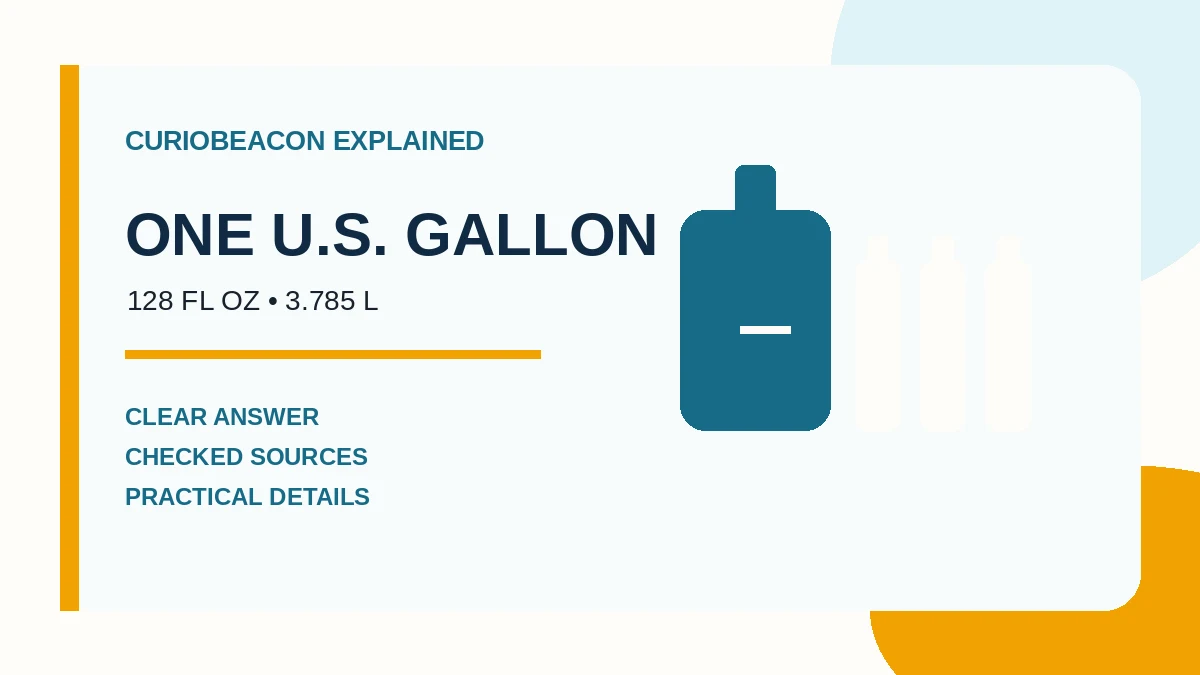
One U.S. gallon equals 128 U.S. fluid ounces, so the number of bottles depends on the capacity printed on each bottle. A gallon fills about 7.57 standard 16.9-fluid-ounce bottles, which means you need eight full bottles to equal or exceed a gallon. It equals exactly eight 16-ounce bottles, 6.4 20-ounce bottles, or about 3.79 one-liter bottles.
Convert a gallon into bottles
Enter the capacity of one bottle and choose its unit. The calculator uses a U.S. liquid gallon, not an Imperial gallon.
A U.S. gallon contains about 7.57 bottles of 16.9 fl oz, so 8 full bottles meet or exceed one gallon.
Without JavaScript: divide 128 by the bottle size in U.S. fluid ounces, or divide 3,785.411784 by the bottle size in milliliters.
Common bottle sizes
| Bottle label | Exact or calculated amount | Whole bottles needed to reach at least one gallon |
|---|---|---|
| 8 fl oz | 16 bottles | 16 |
| 12 fl oz | 10.67 bottles | 11 |
| 16 fl oz | 8 bottles | 8 |
| 16.9 fl oz (500 mL label) | About 7.57 bottles | 8 |
| 20 fl oz | 6.4 bottles | 7 |
| 1 liter | 3.785 bottles | 4 |
The formula
For a bottle labeled in U.S. fluid ounces:
bottles = 128 ÷ bottle size in fluid ounces
For a metric label:
bottles = 3,785.411784 ÷ bottle size in milliliters
The first result can include part of a bottle. If you need sealed, full bottles that contain at least a gallon altogether, round that result up to the next whole bottle. For example, 128 ÷ 16.9 is about 7.57, so seven bottles are short and eight bottles are enough.
Why the label can make the answer look different
A bottle marketed as 500 mL may also display 16.9 fl oz, a rounded U.S. customary value. Using the metric label gives 3,785.411784 ÷ 500 = 7.5708 bottles. Using the rounded 16.9 fl oz label gives 128 ÷ 16.9 = 7.5740. That small difference comes from label rounding, not from a different gallon.
“Gallon” can also mean an Imperial gallon outside the United States. An Imperial gallon is larger, so do not use the U.S. figures above when a product or question explicitly says Imperial. CurioBeacon’s calculator uses the U.S. gallon because this article serves a U.S. audience.
What the number does and does not tell you
This calculation compares container volume only. It does not determine how much water a particular person should drink. Individual fluid needs vary with health, activity, climate, diet, pregnancy, medications, and other factors. Use the bottle count to plan or measure volume—not as a personal hydration prescription.
Related CurioBeacon answers
For another container-size calculation, see How Many Beers Are in a Keg?. For a practical kitchen method, read How to Dice an Onion?.
Sources
Checked August 22, 2026.